
How National Mechanical Services uses operational due diligence to separate good companies from great investments.
There is a moment in nearly every acquisition process when the numbers stop telling the story.
Up until that point, the work is familiar. Financial statements have been analyzed. Tax returns have been reviewed. Customer concentration has been measured. Margins have been normalized. The data room begins to fill with contracts, insurance policies, equipment lists, and organizational charts. An investment thesis starts to take shape, built on assumptions supported by financial performance.
Then comes the site visit.
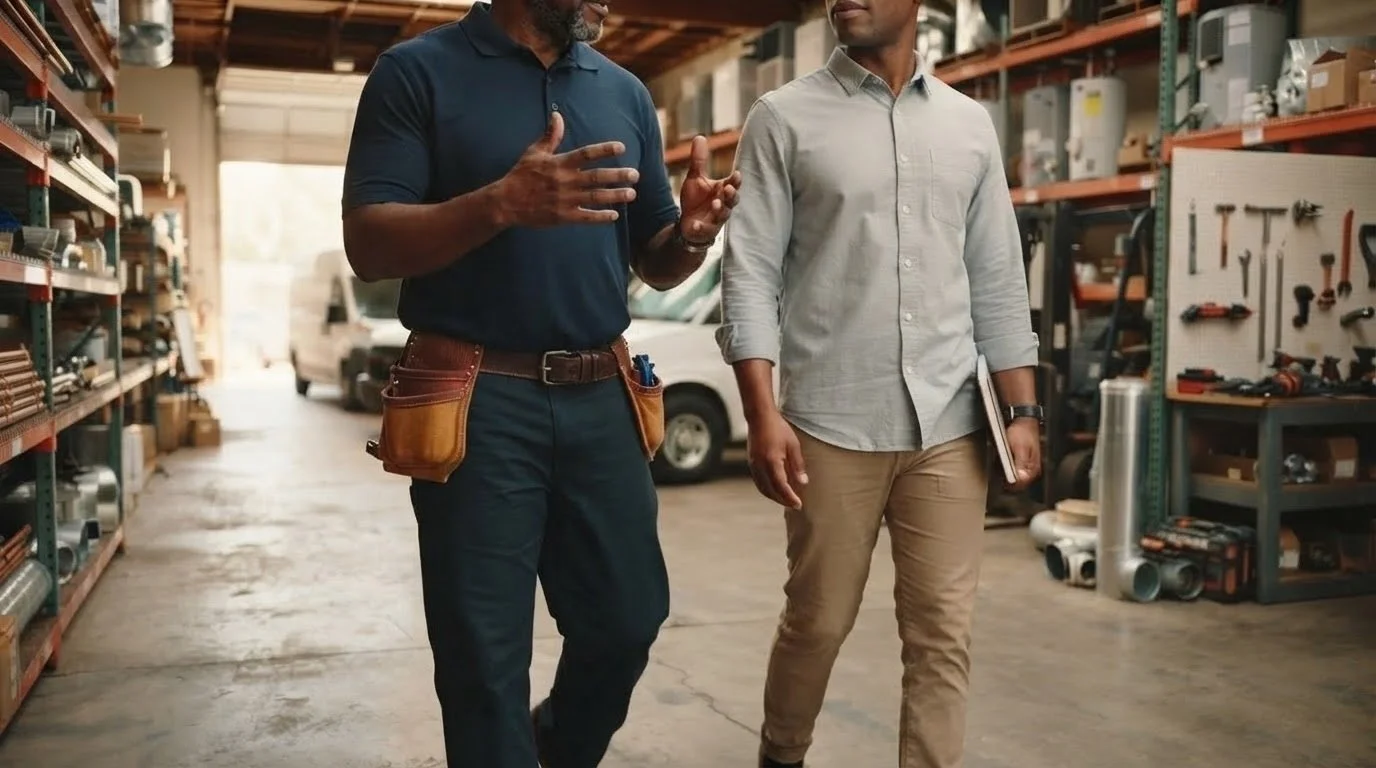
For many buyers, a site visit is little more than a formality—a chance to meet the seller, walk through the building, and put faces to names before moving toward closing. At National Mechanical Services, we see it very differently.
The site visit is where our investment thesis is tested against reality.
It is where numbers become people, processes become visible, and assumptions are either reinforced or challenged. It is often the first opportunity to experience the business as customers and employees experience it every day. More importantly, it is where we begin to understand whether we are acquiring a company with a durable operating foundation or simply purchasing the results of an extraordinary owner.
That distinction matters.
A financial statement captures what a business has accomplished. It cannot explain how those results were achieved or whether they can be sustained after a change in ownership. Two companies with identical revenue and EBITDA may represent entirely different investment opportunities once you step inside their facilities.
One organization may operate with clearly documented systems, empowered managers, engaged technicians, and disciplined operational controls. Another may produce similar financial results because one owner has spent twenty years personally solving every problem, answering every customer call, approving every invoice, and carrying the institutional knowledge of the entire company.
Those businesses may look remarkably similar in a spreadsheet.
They are not remotely the same investment.
That is why our team spends as much time observing as we do asking questions.
As we walk through a facility, we are paying attention to details that rarely appear on a diligence checklist. We notice how employees interact with one another. We observe whether the warehouse reflects organization or constant reaction. We look at how inventory is managed, whether technicians take pride in their vehicles, and whether safety is treated as a compliance exercise or simply part of the company's culture. We watch how dispatch communicates with the field and how managers respond when unexpected issues arise.
Individually, none of these observations determine whether we pursue an acquisition.
Collectively, they tell the story of how the business has been led.
Every company eventually becomes a reflection of its leadership. The culture, the systems, the accountability, and even the condition of the physical workspace are often the cumulative result of thousands of management decisions made over many years. Financial statements may reveal the outcome of those decisions. Walking the business reveals the decisions themselves.
There have been occasions when a site visit strengthened our conviction in an acquisition. The financial performance suggested a healthy business, but seeing the pride employees took in their work, the trust that existed between field teams and management, and the discipline of daily operations revealed something even more valuable. We were not simply looking at historical earnings. We were looking at an organization capable of continuing to perform long after the ownership transition.
There have also been times when the opposite occurred.
A company may present attractive financial performance while subtle operational weaknesses become increasingly apparent once we spend time inside the business. Processes exist only in the owner's head. Management responsibilities are concentrated in one individual. Equipment maintenance is inconsistent. Employees appear uncertain about roles and responsibilities. None of these issues may appear significant in isolation, but together they fundamentally change the level of execution risk associated with the acquisition.
That is precisely why due diligence exists.
The objective is not to confirm that every deal should close. The objective is to develop enough understanding to know when it should not.
Walking away from an acquisition after completing thorough diligence is not evidence that the process failed. In many cases, it is evidence that the process worked exactly as intended.
This philosophy has become a foundational element of how National Mechanical Services evaluates every acquisition opportunity. As our acquisition strategy has matured, we have continued refining what we believe are the most reliable indicators of long-term enterprise value. Those observations have evolved into what we internally call 30XPULSE™, our proprietary framework for evaluating acquisition opportunities beyond financial performance alone.
30XPULSE™
30XPULSE was built on a simple premise: exceptional businesses are rarely defined by numbers alone. Financial performance matters, but sustainable value is created through leadership, operational discipline, workforce quality, customer relationships, safety culture, technology adoption, and an organization's ability to continue performing after ownership changes. Every site visit becomes an opportunity to evaluate those characteristics in ways that no financial model can replicate.
For investors, this discipline should provide confidence.
Growth through acquisition is often measured by the number of companies acquired or the speed at which transactions close. We believe those are incomplete measures of success. Sustainable growth is not built by closing the greatest number of deals. It is built by consistently selecting the right ones.
The best acquirers understand that due diligence is not designed to validate optimism. It is designed to eliminate uncertainty wherever possible. Every hour spent inside a business before closing reduces the likelihood of discovering surprises afterward.
Ultimately, a site visit reminds us that businesses are not collections of assets. They are living organizations built by people, shaped by leadership, and sustained through culture. Financial statements may tell us where a company has been, but only by walking through its operations can we begin to understand where it is capable of going.
At National Mechanical Services, that understanding is one of the most valuable forms of diligence we perform. It is not simply another step in the acquisition process. It is often the moment when an acquisition is either confirmed—or rewritten.
