

The Southeast Trades Exit Planning Center
Operator-Led Guidance for Selling Plumbing, HVAC & Mechanical Businesses
If you are considering selling your plumbing, HVAC, electrical, or mechanical company in Georgia, Alabama, or Tennessee, this center is designed for you.
National Mechanical Services created the Southeast Trades Exit Planning Center to provide practical, operator-led guidance for founder-owned businesses generating between $2M and $50M in annual revenue with 20%+ EBITDA margins.
Selling a trades business is not just a financial event.
It is a transition of people, relationships, reputation, and legacy.
This resource exists to help you approach that transition with clarity.


From the Desk of an Operator
“For years, I have operated in the plumbing and mechanical trades. I understand the realities of running crews, managing dispatch, dealing with labor shortages, maintaining fleet reliability, and protecting service margins.
When the time comes to consider succession or sale, those operational realities matter.
The articles and tools in this center are built from an operator’s perspective — not from a broker’s script.”
— Emmett
Co-Founder & COO
National Mechanical Services
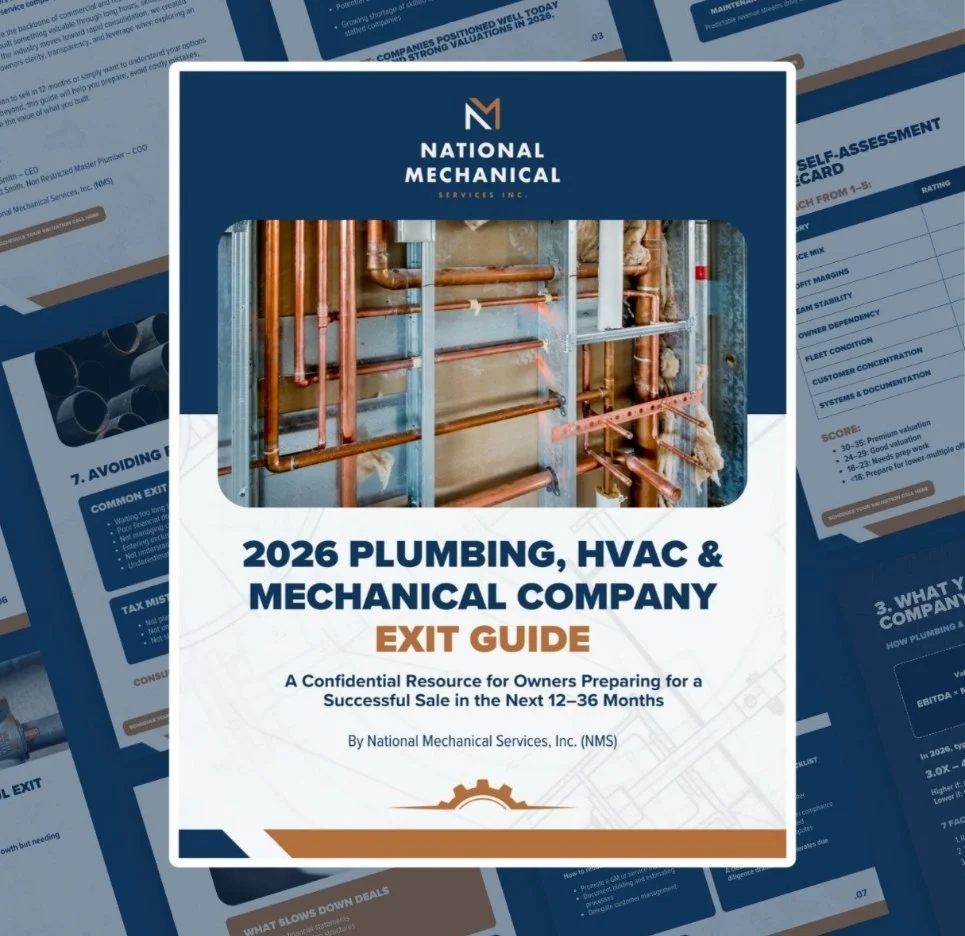
Start Here: Download the Plumbing & Mechanical Exit Guide
If you are early in the process, begin with our comprehensive Exit Guide.
Inside you will learn:
✔ How plumbing and HVAC businesses are valued
✔ EBITDA vs SDE explained
✔ What increases valuation multiples
✔ How to prepare your financials
✔ Transaction timelines
✔ Common seller mistakes
Core Exit Education
These cornerstone resources are designed to answer the most common questions trades business owners ask when considering an exit.

Geographic Exit Resources
We actively work with founder-owned trades companies across the Southeast.
location-specific guidance coming soon!

Preparing for Due Diligence
If you are considering a sale within the next 12–24 months, preparation can materially increase valuation.
We recommend focusing on:
✔ Cleaning up financial reporting
✔ Documenting add-backs clearly
✔ Improving service revenue percentage
✔ Strengthening management depth
✔ Organizing contracts and customer agreements
Early preparation reduces friction and improves leverage during negotiation.

Market Intelligence & Valuation Trends
The Southeast plumbing, HVAC, and mechanical market continues to experience consolidation activity.
We publish periodic updates on:
✔ The importance of field leadership
✔ The impact of labor on margin
✔ The realities of dispatch efficiency
✔ Fleet lifecycle costs
✔ The value of recurring service relationships
This perspective reduces integration risk and protects continuity.

Why Operator-Led Buyers Matter
Not all buyers approach trades businesses the same way.
Operator-led platforms understand:
✔ The importance of field leadership
✔ The impact of labor on margin
✔ The realities of dispatch efficiency
✔ Fleet lifecycle costs
✔ The value of recurring service relationships
This perspective reduces integration risk and protects continuity.

Ready for a Confidential Conversation?
Exploring a potential sale does not obligate you to transact. It simply provides clarity.
If you own a plumbing, HVAC, electrical, or mechanical company generating $2M–$35M in revenue with 10%+ EBITDA margins in Georgia, Alabama, or Tennessee, we welcome a confidential discussion.
Frequently Asked Questions About Selling a Trades Business
Selling your plumbing, HVAC, or mechanical company raises important questions
-
The value of your business is typically based on a multiple of its EBITDA (Earnings Before Interest, Taxes, Depreciation, and Amortization)—but the multiple can vary significantly depending on the quality of the business.
Most companies in the plumbing, HVAC, and mechanical services space trade between 3x and 7x EBITDA, with premium businesses achieving even higher valuations.
What determines where my business falls in that range?
Not all revenue is valued equally. Buyers look at a combination of factors that influence both risk and growth potential:
Higher Valuation Drivers
Strong service contract base (recurring revenue)
Consistent profitability and clean financials
Diversified customer base
Established management team (not owner-dependent)
Scalable operations and systems
Growth opportunities (geographic, service lines, add-ons)
Lower Valuation Drivers
Heavy reliance on one-time project revenue
Owner-dependent relationships or operations
Inconsistent or unclear financials
Customer concentration
Limited systems or infrastructure
How does EBITDA impact my valuation?
EBITDA represents the true earning power of your business.
For example:
A business generating $1M in EBITDA may be worth $3M–$7M+, depending on quality
A business generating $3M in EBITDA could command $12M–$21M+ with the right fundamentals
The multiple applied is where strategy—and preparation—makes a significant difference.
What is “adjusted” or “normalized” EBITDA?
Buyers will often adjust your EBITDA to reflect the true performance of the business by:
Removing one-time or non-recurring expenses
Adjusting owner compensation to market rates
Normalizing discretionary or personal expenses
This process can often increase valuation when properly presented.
How does NMS approach valuation?
At NMS, we take a practical and transparent approach.
We evaluate:
Current performance and profitability
Strength of recurring revenue and contracts
Operational infrastructure and team
Opportunities to grow and scale post-acquisition
We are not just valuing what your business is today—we are also underwriting what it can become within our platform.
Can I increase my valuation before selling?
Yes—and in many cases, significantly.
Key areas that drive value:
Increasing service agreements and recurring revenue
Cleaning up financials and reporting
Reducing owner dependency
Improving margins and operational efficiency
Building a strong leadership team
Even small improvements in these areas can lead to meaningful increases in purchase price.
Bottom line
Your business is not just valued on revenue—it is valued on profitability, predictability, and scalability.
The stronger those fundamentals, the higher your valuation—and the more options you will have at exit.
-
The timeline to sell your business typically ranges from 3 to 6 months, depending on preparation, deal complexity, and buyer alignment.
At NMS, our goal is to move efficiently—without sacrificing deal quality or certainty.
What does the typical timeline look like?
While every transaction is different, most follow a structured process:
Preparation (2–6 weeks)
Organizing financials, understanding operations, and positioning the business for sale.Initial Review & Offer (2–4 weeks)
Buyer evaluation, discussions, and issuance of a Letter of Intent (LOI).Due Diligence (4–8 weeks)
Deep dive into financials, operations, contracts, and risk areas.Closing (2–4 weeks)
Final agreements, financing, and transition planning.
What can slow the process down?
Several factors can extend the timeline:
Disorganized or incomplete financials
Unclear revenue streams or margins
Customer concentration or contract gaps
Delays in responsiveness during diligence
Complex deal structures or financing
The more prepared your business is, the faster—and smoother—the process will be.
What can speed it up?
Transactions move faster when:
Financials are clean and easy to verify
Service contracts and recurring revenue are well documented
Leadership and team structure are clear
Sellers are responsive and engaged
There is alignment on valuation and deal structure early
Working with a buyer like NMS—who understands your industry—also significantly reduces friction.
Can it happen faster?
Yes. In some cases, deals can close in as little as 60–90 days, particularly when:
The business is well-prepared
There is strong alignment between buyer and seller
The transaction is straightforward
How does NMS approach timing?
We prioritize:
Efficient decision-making
Clear communication
A streamlined diligence process
Our experience in plumbing, HVAC, and mechanical services allows us to quickly understand your business and move with confidence.
Bottom line
Selling your business is not an overnight process—but it does not have to take a year.
With the right preparation and the right partner, you can achieve a smooth, timely, and successful exit—often within a few months.
-
No—audited financials are not required to sell your business.
However, the quality and organization of your financials will directly impact buyer confidence, valuation, and speed to close.
What financials do buyers actually expect?
Most buyers—including NMS—typically look for:
Profit & Loss Statements (last 3 years + current YTD)
Balance Sheets
Tax Returns
Revenue breakdown (service vs. project work)
Customer and contract visibility
Clean, consistent, and well-documented financials are far more important than whether they are formally audited.
When do audited financials matter?
Audits are usually only necessary in more complex situations, such as:
Larger transactions or institutional buyers
Businesses with complicated revenue recognition
Situations where financials are unclear or inconsistent
Preparing for a formal private equity process
For most lower middle-market businesses, reviewed or internally prepared financials are sufficient.
What matters more than an audit?
Buyers prioritize clarity and credibility:
Are your numbers consistent across reports?
Can revenue and margins be easily verified?
Is there a clear story behind growth and profitability?
A well-prepared set of financials—even if unaudited—can often outperform poorly organized audited statements.
How does NMS approach financials?
At NMS, we work with business owners at various stages of financial sophistication.
We focus on:
Understanding the true earning power of the business
Normalizing EBITDA where appropriate
Identifying opportunities to improve reporting and margins
If your financials need refinement, we can help guide that process as part of our evaluation.
What can I do to prepare?
Before going to market, we recommend:
Cleaning up bookkeeping and ensuring consistency
Separating personal and business expenses
Clearly categorizing revenue streams
Working with a CPA to validate accuracy
These steps can materially improve both valuation and deal certainty.
Bottom line
You do not need audited financials to sell—but you do need clear, reliable, and defensible numbers.
The better your financial story, the stronger your position in an exit.
-
Yes—and in many cases, we encourage it.
At NMS, we understand that owners have spent years—often decades—building their businesses. Transitioning out does not have to mean walking away entirely.
What does “staying involved” look like?
Your level of involvement is flexible and tailored to your goals. Common structures include:
Transition Period (3–12 months)
Supporting leadership, relationships, and operational continuity post-close.Ongoing Leadership Role
Remaining as an operator, division leader, or market president.Advisory Role
Providing strategic insight while stepping back from day-to-day operations.Equity Rollover
Retaining ownership in the larger NMS platform and participating in future upside.
Why would I stay involved?
Many sellers choose to remain involved because:
They want to protect their legacy and team
They see additional upside in continued growth
They prefer a phased transition, not an abrupt exit
They want to de-risk financially while still participating in value creation
How does NMS structure this?
We approach every transition with flexibility.
Our goal is to align with what matters most to you:
Full exit and clean transition
Continued leadership and operational involvement
Strategic participation with reduced day-to-day responsibility
We structure roles, compensation, and any retained equity to ensure alignment across all parties.
What if I want to step away completely?
That is absolutely an option.
We have the infrastructure, leadership, and operational systems to ensure a smooth transition while maintaining continuity for your employees and customers.
Bottom line
Selling your business does not have to be an all-or-nothing decision.
With NMS, you can exit, stay, or design something in between—all while ensuring your business is positioned for long-term success.
-
Service contracts are one of the most valuable assets in a mechanical services business—and often the difference between an average valuation and a premium outcome.
What makes service contracts valuable?
At their core, service contracts represent predictable, recurring revenue. Buyers place a premium on this because it reduces risk and increases visibility into future cash flow.
The more your business can demonstrate:
Long-term customer relationships
High renewal rates
Contractual pricing with built-in increases
Diversification across clients and industries
…the more attractive—and valuable—your company becomes.